Retail Sales Report July 2026: What to Watch Friday
Comes out: Friday, August 14, 2026 at 8:30 a.m. ET
Published by: U.S. Census Bureau
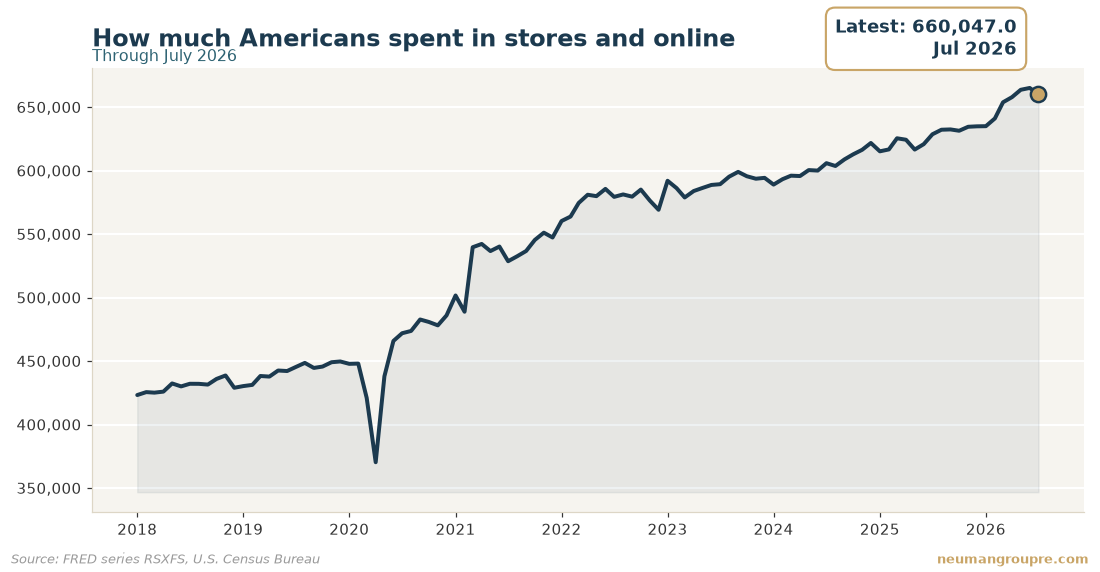
660,047.0: retail spending slipped in July, still up over the year
Retail sales for July 2026 came in at 660,047.0. That number, reported in millions of dollars, is how much people spent in stores and online across the country in one month. It slipped from 665,054.0 the month before.
Compared with a year ago, spending is still up. It was 628,581.0 back then, so people are spending more now than they did last year, even with this recent dip.
Why care about a shopping number when you are thinking about a home? Spending shows whether households still have money left after the bills. When that money holds up, buyers tend to feel more sure about making a big move.
For South Florida, a one-month dip like this is small and does not change much on its own. If you are a buyer, it is not a reason to rush or to wait. If you are a seller or an owner, it points to demand that is softer than last month but still stronger than a year ago.
The smart move is to watch the trend over several months, not one report. Prices, payments and your own budget matter far more to your deal than a single spending figure.
A big spending report comes out on Friday, August 14, 2026 at 8:30 a.m. Eastern Time. It is called Advance Retail Sales, and the U.S. Census Bureau puts it out each month.
The report adds up how much money people spent in stores and online. It is a quick read on whether households still have cash left after paying the bills.
If you are trying to buy, sell, or rent a home in Miami-Dade, Broward, or Palm Beach, this number matters more than it looks. Spending shapes how confident buyers feel, and that feeling shows up in home prices and rents.
What this report actually measures
Retail sales are the total dollars people spend at stores and websites. Think cars, gas, groceries, clothes, furniture, and online orders. The Census Bureau adds it all up for the whole country and reports one big total each month.
The word advance just means it is the first, fast version of the number. It comes out quickly, so it can be revised later when more data comes in. It is an early snapshot, not the final word.
Why should a normal person care? Because spending is a mood ring for the economy. When people feel good about their money, they spend and they shop for homes. When they get nervous, they hold back.
What the charts show right now
The chart above shows spending for June 2026 at 666,056.0. That figure is in millions of dollars, so it is the total for the whole country in one month.
The month before, in May 2026, the total was 664,439.0. So June was about the same as May. Spending held steady rather than jumping or dropping.
Now look further back. A year earlier the total was 621,374.0. Compared to a year ago, spending is up. So the longer trend is people spending more, even if month to month it has leveled off lately.
What it means for your mortgage payment
This report does not set your loan rate. But it feeds into the mood that moves rates. A mortgage is the loan you use to buy a home, paid back monthly over many years.
Here is the link in plain words. Strong, rising spending can push rates up, because it can signal prices climbing across the economy. Weak spending can pull rates down, because it hints the economy is cooling. On a $600,000 loan, even a small move in your rate changes your monthly payment. Higher rates mean a bigger payment. Lower rates mean a smaller one.
What it means for home prices
When people feel secure about their paychecks, more of them shop for homes. More buyers competing for the same houses tends to hold prices up or push them higher.
When spending stalls or falls, some buyers wait. Fewer buyers can cool prices, or at least slow how fast they rise. So this report is one clue about how much competition a seller might face this fall.
What it means for rent in South Florida
Rent moves with the same mood. When households feel steady, more people are willing to sign a lease or pay a bit more for the place they want.
If you own a place and rent it out, strong spending usually means steadier demand from renters. If spending weakens, renters get pickier and push back harder on price. If you are the one renting, a softer spending report can mean a little more room to negotiate.
The bottom line
You do not need to guess tomorrow's number. Just watch the direction. Is spending still climbing, holding flat, or slipping? That direction tells you which way the wind is blowing for buyers, sellers, owners, and renters here in South Florida.
Three things to watch
Questions people ask
What is the Advance Retail Sales report?
It is a monthly count of how much money people spent at stores and online across the whole country. The U.S. Census Bureau publishes it. It is an early, fast estimate that can be revised later.
When does the next report come out?
It comes out Friday, August 14, 2026 at 8:30 a.m. Eastern Time. That is the release covering July spending.
What was the most recent number?
For June 2026, total retail sales were 666,056.0 million dollars. That was about the same as May 2026, which was 664,439.0 million dollars, and up from 621,374.0 million dollars a year earlier.
Does this report change mortgage rates directly?
No. It does not set rates. But it shapes the outlook for the economy, and that outlook can push rates up or down. Strong spending can lift rates, while weak spending can ease them.
How does spending affect home prices and rent in South Florida?
When people feel steady about their money, more of them buy and rent, which supports prices and rents. When spending slows, buyers and renters gain a little more room to negotiate.
Every figure on this page comes straight from FRED (Federal Reserve Economic Data, Federal Reserve Bank of St. Louis) — series RSXFS. We publish these before the report lands so you can read the background while it is still quiet, then we add the actual number here the moment it is out.
Call 954-228-5001 or ask us for a free read on your property.