July 2026 Jobs Report and Unemployment Rate Explained
Comes out: Friday, August 7, 2026 at 8:30 a.m. ET
Published by: U.S. Bureau of Labor Statistics
Unemployment falls to 4.1% in July, down from 4.2%
The unemployment rate is 4.1% for July 2026. That is the share of people who want a job but do not have one. It went down a little from 4.2% the month before. A year ago it was 4.3%, so it is down over the year too.
The country also has 158,858.0 thousand jobs in total. That is about the same as last month, when it was 158,881.0 thousand. A year ago it was 158,542.0 thousand, so the total is about the same over the year as well.
When more people are working, more people can afford to buy or rent a home. That steady job number is one reason home prices and rents in South Florida have held up.
This report also moves mortgage rates, because it is watched closely when rates are set. A small change in the rate changes your monthly payment. On a $600,000 loan, a rate that is even a little lower can save you real money each month, so it pays to check where rates land after news like this.
If you are buying, selling, or renting and want to know what today's numbers mean for your plans, call The Neuman Group at 954-228-5001.
A big report on jobs comes out on Friday, August 7, 2026, at 8:30 a.m. Eastern time. It is called the Employment Situation, and most people just call it the jobs report.
It sounds like Washington news. But it touches your wallet. Jobs move rent, home prices, and mortgage rates.
This page explains what the report is, what the numbers say right now, and what tomorrow's figure could mean for you if you rent, own, buy, or sell in South Florida.
What the jobs report actually measures
Once a month, the U.S. Bureau of Labor Statistics counts two big things. First, how many people have jobs. Second, how many people want a job but cannot find one.
That second group gives us the unemployment rate. It is the share of people who want to work but do not have a job. When the rate goes down, more people are working. When it goes up, fewer people are working.
The report also counts total jobs in the country. More total jobs means the economy is growing. Fewer jobs means it is slowing down.
What the charts show right now
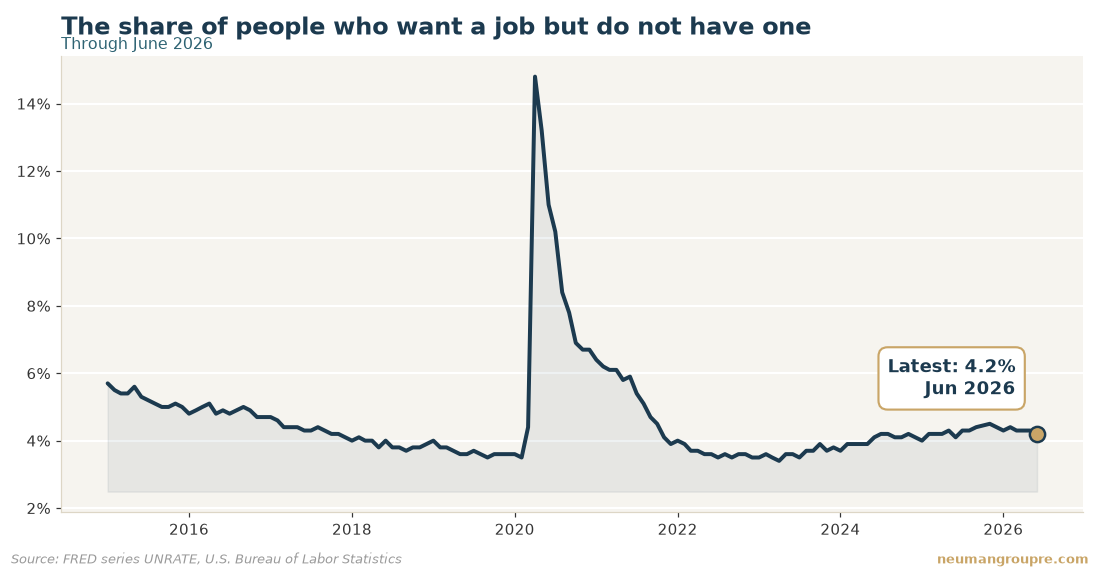
The chart above shows the national unemployment rate at 4.2% for June 2026. That is down from 4.3% the month before. A year ago it was 4.1%, so it is a little higher than last year but still low.
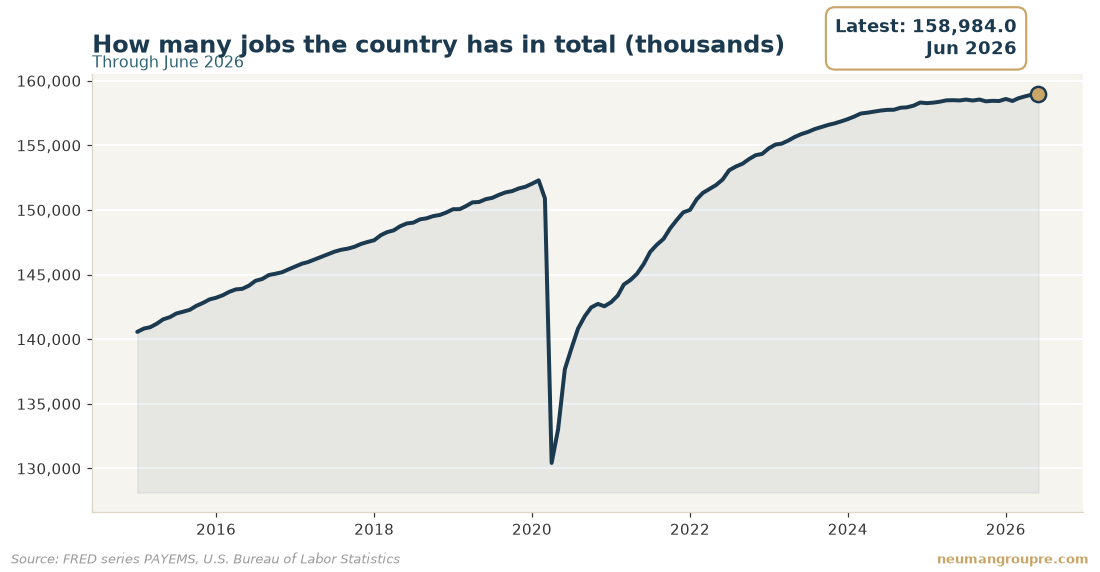
The chart of total jobs shows 158,984.0 thousand jobs in June 2026. That is about the same as the month before, and up from 158,478.0 thousand a year ago. So the country is still adding jobs, just slowly.
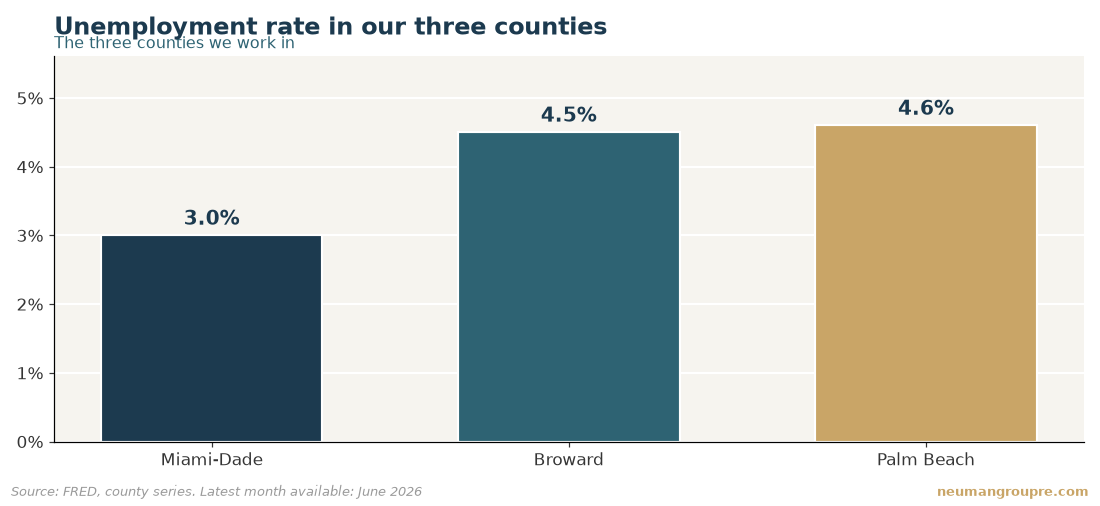
Closer to home, the local chart shows June 2026 unemployment at 3.0% in Miami-Dade, 4.5% in Broward, and 4.6% in Palm Beach. All three are higher than a year ago. Miami-Dade was 2.6%, Broward was 3.7%, and Palm Beach was 3.9%.
What it means for your mortgage payment
Mortgage rates do not come straight from this report. But they move with it. The Federal Reserve, the group that sets a key interest rate for the whole country, watches the jobs report closely.
Here is the simple version. A weak jobs report can push mortgage rates down. A strong one can push them up. Even a small rate change matters on a big loan. On a $600,000 mortgage, a shift in the rate can move your monthly payment by well over a hundred dollars, up or down.
What it means for home prices
When lots of people have steady paychecks, more of them can buy. That keeps demand for homes strong. When jobs get shaky, some buyers wait, and price growth can cool off.
South Florida unemployment is still low by past standards. But it has crept up over the past year. That is worth watching if you plan to buy or sell.
What it means for rent
Rent follows paychecks too. If people are working and earning more, landlords have room to raise the rent. If jobs weaken, renters push back and rents flatten out.
If you own a place and rent it out, the local numbers matter most. If you are a renter, a softer job market can give you a little more room to negotiate.
How to read tomorrow's number
You do not need to guess the exact figure. Just watch the direction. Did the unemployment rate go up or down from 4.2%? Did the country add a lot of jobs or just a few?
A number that comes in weaker than expected can mean lower mortgage rates, but also a softer economy. A stronger number can mean a healthy job market, but rates that stay high. Neither is all good or all bad. It depends on whether you are buying, selling, renting, or holding.
Three things to watch
Unemployment rate in our three counties
| County | Now | A year ago | Direction |
|---|---|---|---|
| Miami-Dade | 3.0% | 2.6% | up |
| Broward | 4.5% | 3.7% | up |
| Palm Beach | 4.6% | 3.9% | up |
County figures from FRED, latest month published: June 2026.
Questions people ask
When does the jobs report come out?
The next Employment Situation report comes out on Friday, August 7, 2026, at 8:30 a.m. Eastern time. It is released by the U.S. Bureau of Labor Statistics. It comes out once a month.
What is the unemployment rate right now?
The most recent national unemployment rate is 4.2% for June 2026. That is down from 4.3% the month before. A year ago it was 4.1%.
Why does the jobs report affect mortgage rates?
The Federal Reserve, the group that sets a key national interest rate, watches this report closely. A weak report can push mortgage rates down. A strong report can push them up.
What is the unemployment rate in South Florida?
In June 2026 it was 3.0% in Miami-Dade, 4.5% in Broward, and 4.6% in Palm Beach. All three are higher than a year ago. They are still low by past standards.
Should I wait for this report to buy or sell?
One report should not decide it for you. Watch the direction over time, not a single number. Your own budget and plans matter more than any one month.
Every figure on this page comes straight from FRED (Federal Reserve Economic Data, Federal Reserve Bank of St. Louis) — series PAYEMS, UNRATE. We publish these before the report lands so you can read the background while it is still quiet, then we add the actual number here the moment it is out.
Call 954-228-5001 or ask us for a free read on your property.