JOLTS Job Openings Report, September 2026 Explained
Comes out: Tuesday, September 29, 2026 at 10:00 a.m. ET
Published by: U.S. Bureau of Labor Statistics
7,079K open jobs in August, down from 7,335K
The new number: 7,079K open jobs. This counts how many jobs employers across the country are trying to fill. It comes from the U.S. Bureau of Labor Statistics for the month of August 2026. The K just means thousand, so 7,079K is about 7.08 million open jobs.
Last time the number was 7,335K, so open jobs went down. But compared with a year ago, when it was 6,919K, open jobs are up. So there is a small dip from last month, but still more openings than this time last year.
Here is why this matters for you. Open jobs are a promise of future paychecks. When there are lots of jobs to fill, people feel safe signing a mortgage or a lease. When openings pull back a little, some buyers get more careful before taking on a big monthly payment.
A steady jobs picture also helps keep the door open for buyers. On a $600,000 home loan, a change of even half a point in the interest rate can move your monthly payment by roughly $200. Jobs reports like this one are one of the things that push rates up or down over time.
If you are buying, selling, owning or renting in South Florida and want to talk through what this means for your plans, call The Neuman Group at 954-228-5001.
A new jobs report comes out on Tuesday, September 29, 2026, at 10:00 a.m. Eastern Time. It is called the JOLTS report. JOLTS stands for Job Openings and Labor Turnover Survey. In plain words, it counts how many open jobs employers are trying to fill.
You may not think a jobs report has anything to do with your house. It does. Open jobs are a sign of future paychecks. When there are lots of open jobs, people feel safe signing a mortgage or a lease. When openings dry up, people get careful with big money moves.
This page is here before the new number lands. Below we explain what the report measures, what the charts already show, and what a higher or lower number could mean for you here in Miami-Dade, Broward, and Palm Beach.
What the JOLTS report actually measures
The report is put out by the U.S. Bureau of Labor Statistics, a government agency that counts jobs and prices. JOLTS counts open jobs across the country. An open job is a spot an employer wants to fill and could start filling right away.
Think of it as a help-wanted count for the whole country. More open jobs usually means employers want to hire. Fewer open jobs usually means they are pulling back.
What the charts show right now
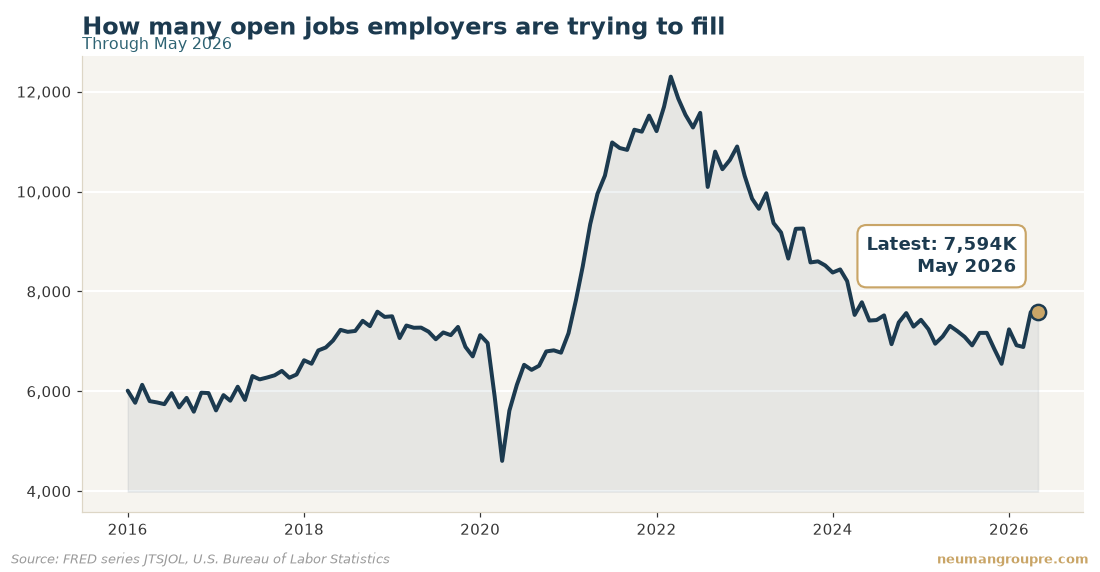
The chart above shows the number of open jobs across the country. The latest count is 7,271K for July 2026. That is about 7.27 million open jobs. (The K just means thousands.)
That number is up from 7,182K the month before. It is also up from 7,089K a year earlier. So open jobs have been rising, not falling. That points to steady demand for workers.
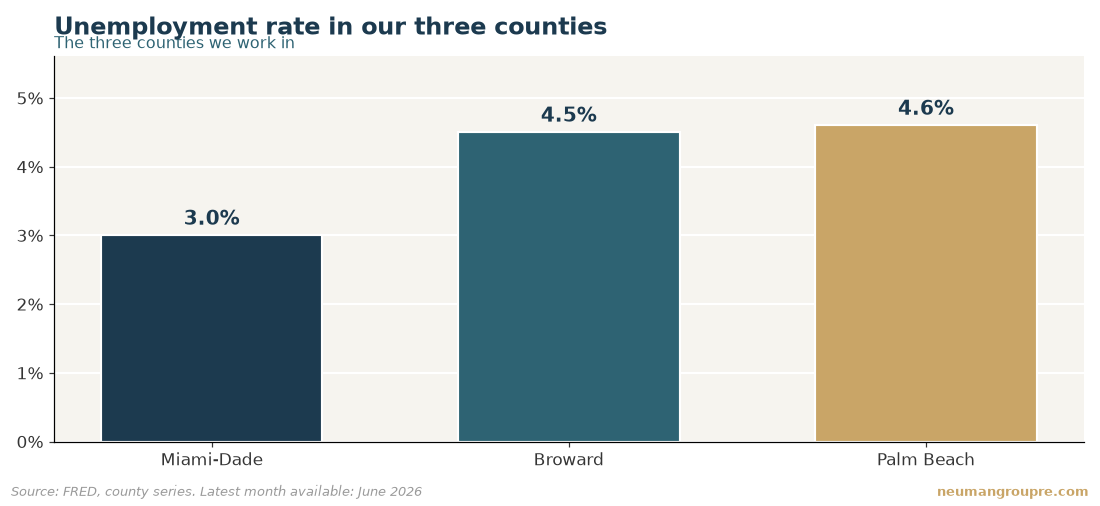
We also track the unemployment rate in our three counties. The unemployment rate is the share of people who want a job and cannot find one. In Miami-Dade it was 2.5% in July 2026, down from 2.9% a year earlier. In Broward it was 4.6%, up from 3.9%. In Palm Beach it was 4.8%, up from 4.1%. So the local picture is mixed. One county improved, and two moved the other way.
What it means for your mortgage payment
JOLTS does not set your mortgage rate. But it feeds a bigger story about the job market. A hot job market can push rates up. A cooling job market can pull rates down. Rates move on many reports, not just this one.
Here is why the direction matters to you. On a $600,000 home loan, even a small change in your rate can change your monthly payment by a real amount over 30 years. So the trend behind reports like this one can shape what you pay each month.
What it means for home prices
When lots of people feel safe about their jobs, more of them shop for homes. More buyers competing for the same houses tends to hold prices up. If open jobs fall hard and people worry, some buyers step back. Fewer buyers can cool prices or slow how fast homes sell.
What it means for rent
Rent follows jobs too. If people feel secure, they are more willing to sign a lease or renew one. That supports rent. If the job market weakens, some renters double up or hold off on a move. That can soften rent or make units sit empty longer.
How to read tomorrow's number
Do not get stuck on one month. Look at the direction over time. Is the open-job count rising, falling, or holding flat? One report is a single dot. The trend is what moves rates, prices, and rent.
If you are buying, selling, renting out a place, or holding a mortgage in South Florida, the safest move is to watch the trend and plan for a range of outcomes. We are happy to talk through what any result could mean for your own situation.
Three things to watch
Unemployment rate in our three counties
| County | Now | A year ago | Direction |
|---|---|---|---|
| Miami-Dade | 2.5% | 2.9% | down |
| Broward | 4.6% | 3.9% | up |
| Palm Beach | 4.8% | 4.1% | up |
County figures from FRED, latest month published: July 2026.
Questions people ask
What is the JOLTS report?
JOLTS stands for Job Openings and Labor Turnover Survey. It is a monthly count of open jobs from the U.S. Bureau of Labor Statistics. It shows how many spots employers are trying to fill.
When does the job openings report come out?
The next report lands on Tuesday, September 29, 2026, at 10:00 a.m. Eastern Time. The figures cover the prior months, so the newest data will be for a month earlier than the release date.
How many job openings are there now?
The latest count is 7,271K, or about 7.27 million open jobs, for July 2026. That is up from 7,182K the month before and up from 7,089K a year earlier.
Does the jobs report change my mortgage rate?
Not directly. JOLTS does not set rates. But it is part of the job-market picture that lenders and markets watch. A hot job market can push rates up, and a cooling one can pull them down.
What does this mean for South Florida housing?
Open jobs mean paychecks, and paychecks let people buy or rent with confidence. Strong openings tend to support prices and rent here. A clear drop could make buyers and renters more cautious.
Every figure on this page comes straight from FRED (Federal Reserve Economic Data, Federal Reserve Bank of St. Louis) — series JTSJOL. We publish these before the report lands so you can read the background while it is still quiet, then we add the actual number here the moment it is out.
Call 954-228-5001 or ask us for a free read on your property.