GDP Report September 2026: What to Watch
Comes out: Wednesday, September 30, 2026 at 8:30 a.m. ET
Published by: U.S. Bureau of Economic Analysis
A big economic report comes out on Wednesday, September 30, 2026 at 8:30 a.m. Eastern Time. It is called Gross Domestic Product, or GDP for short. GDP is the total value of everything the country makes and sells.
Think of GDP as the scoreboard for the whole economy. It tells you if the country is growing or slowing down.
Why should you care? Because the health of the economy shapes what happens to home prices, rent, and mortgage rates here in South Florida. This page explains what the number means before it lands, so you know what to look for.
What this report actually measures
GDP adds up the value of all the goods and services the country makes. That means cars, houses, haircuts, and everything in between. When GDP goes up, the economy is making more. When it goes down, the economy is making less.
The number comes from the U.S. Bureau of Economic Analysis. That is a government office that tracks the size of the economy. They take out the effect of rising prices, so you are seeing real growth and not just higher price tags. This version is called Real Gross Domestic Product.
What the charts show right now
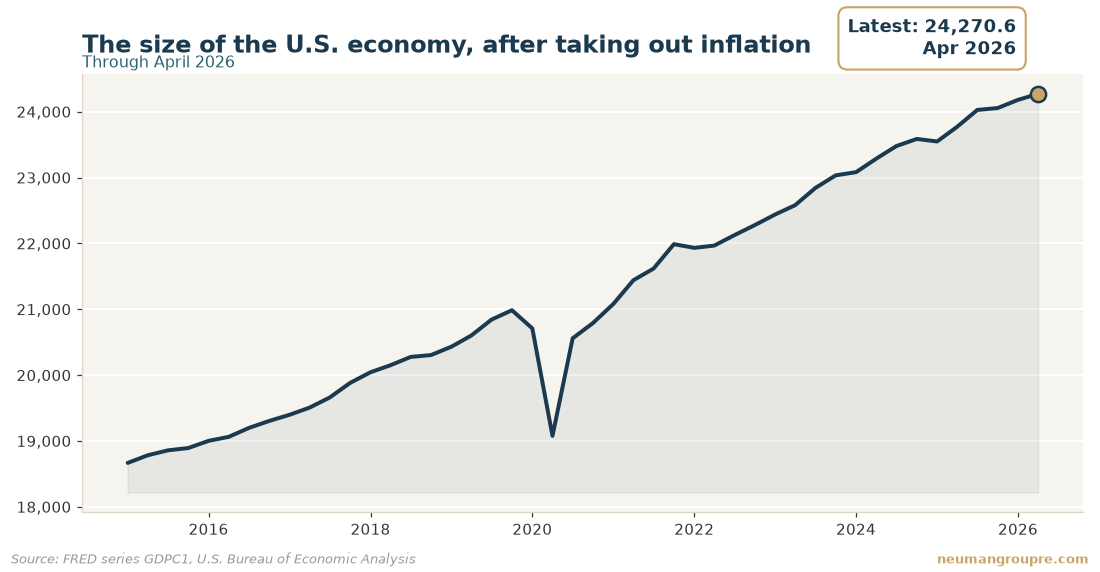
The chart above shows the size of the economy over time. The most recent reading is 24,269.6 for April 2026. The time before that it was 24,180.4. So the economy grew.
A year ago the number was 23,771.0. Compared to that, the economy is also up. So the trend has been growth, both over the last stretch and over the full year.
Tomorrow's report will add a fresh number to that picture. We do not know what it will be yet. The thing to watch is the direction: does the economy keep growing, does it slow down, or does it shrink?
What it means for your mortgage payment
GDP does not set mortgage rates by itself. But it feeds into the mood of lenders. When the economy runs hot, lenders often expect higher rates. When it cools, rates can ease.
Here is why that matters in dollars. Say you borrow $600,000 to buy a home. A small move in your rate changes your monthly payment by a real amount. On a loan that size, a rate that is one percent higher can add hundreds of dollars to what you pay each month. So the direction of the economy can touch your budget.
What it means for home prices
A growing economy means more people feel safe buying. More buyers can mean more competition for the same homes. That tends to hold prices up.
A slowing economy does the opposite. Buyers get cautious. Some wait. That can take pressure off prices and give buyers more room to negotiate.
What it means for rent in South Florida
Rent follows jobs and confidence. When the economy is strong, more people move and look for places to live. That keeps demand for rentals high across Miami-Dade, Broward, and Palm Beach.
When the economy slows, some renters stay put or double up. Demand can soften. If you own a place and rent it out, a strong economy usually helps you keep it filled. A weak one can mean longer gaps between tenants.
The bottom line
You do not need to guess the exact number. Watch whether the economy is growing or slowing. Then match that to your own plan, whether you are buying, selling, renting out, or paying a mortgage. If you want help reading what it means for your street, call The Neuman Group at 954-228-5001.
Three things to watch
Questions people ask
What is GDP in simple terms?
GDP is the total value of everything the country makes and sells. It is the scoreboard for the whole economy. When it goes up, the economy is growing.
When does the GDP report come out?
It comes out on Wednesday, September 30, 2026 at 8:30 a.m. Eastern Time. It is released by the U.S. Bureau of Economic Analysis.
Does GDP change my mortgage rate?
Not directly. But GDP shapes what lenders expect. A hot economy can push rates up, while a cooling one can let them ease. That affects your monthly payment.
What was the latest GDP number?
The most recent reading was 24,269.6 for April 2026. That was up from 24,180.4 the time before, and up from 23,771.0 a year ago.
Should I wait for this report to buy or sell?
One report rarely changes a good plan. Watch the direction of the economy, then match it to your own needs and timing. A local agent can help you read it.
Every figure on this page comes straight from FRED (Federal Reserve Economic Data, Federal Reserve Bank of St. Louis) — series GDPC1. We publish these before the report lands so you can read the background while it is still quiet, then we add the actual number here the moment it is out.
Call 954-228-5001 or ask us for a free read on your property.